
Metabolism After 40: What Changes, What Doesn't, and What Helps
For most adults, daily calorie burn stays fairly steady from about age 20 to 60. What often shifts after 40 is muscle, sleep, stress, hormones and movement, and those changes can make weight harder to manage. Small, steady habits do the most work. If you are considering a supplement, read the label first.
 By Rebecca Hayes · Updated November 27, 2026
This site may earn a commission if you buy through links on the review page. It does not change what we recommend.
I'm Rebecca, and I wrote this guide for the version of me from about ten years ago. I ate balanced meals. I walked. I did Pilates. And somewhere after 40 the scale stopped following the old rules.
So I started reading. This page is what I learned, in plain words, with links to the sources I trust. I'm not a medical professional. Talk to your doctor before changing your routine or starting a supplement.
What is metabolism, in plain words?
Metabolism is the set of processes your body uses to turn food and drink into energy. It keeps your heart beating, your lungs working and your cells repairing themselves, even while you sleep. Most of the calories you burn each day go to these background jobs.
Think of it as the body's constant, quiet energy budget. A big share goes to simply staying alive. Another share goes to digesting food. The rest goes to movement, from a brisk walk to carrying groceries.
That last share is the part you can influence the most. It is also the part that tends to shrink quietly when life gets busy, or when you sit more than you used to.
Does metabolism really slow down after 40?
Less than most people think. A large study published in Science in 2021 found that calorie burn was the most stable from the 20s through the 50s, and only began a gradual decline after about age 60. So 40 is not a cliff.
The research team, led by Herman Pontzer, looked at energy use in people from infancy to age 95. A summary from Duke University describes the middle decades, "our 20s, 30s, 40s and 50s," as "the most stable." It adds that metabolism does not "really start to decline again until after age 60," at roughly 0.7% a year. You can read the summary at Duke University.
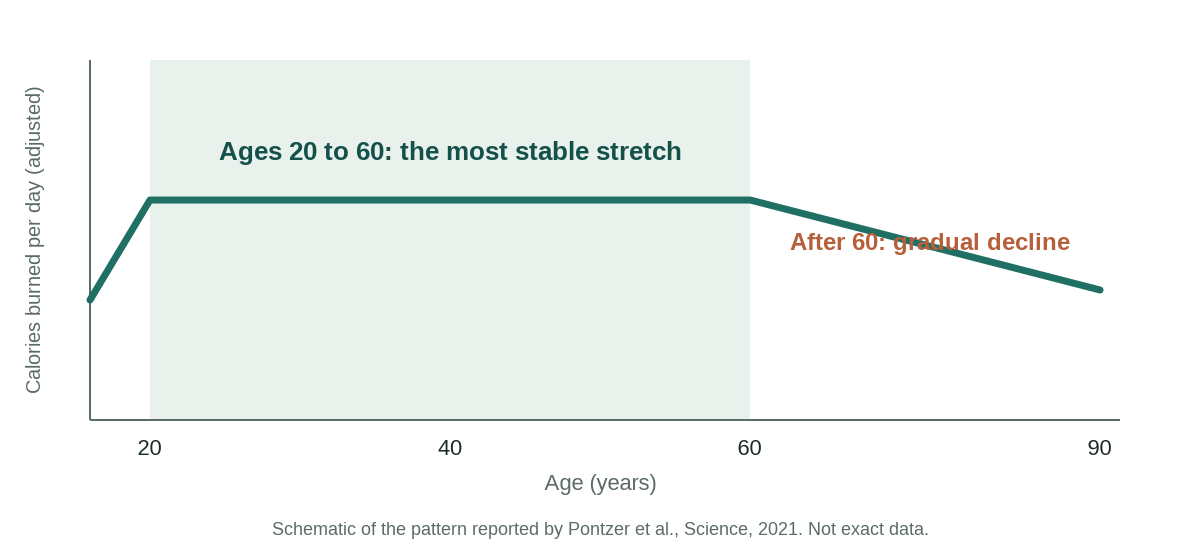
I'll be honest, this surprised me. For years I blamed "my slowing metabolism." The research suggests the story is more mixed than that. The study is Pontzer et al., published in Science in 2021.
Does that mean nothing changes at midlife? No. It means the cause is more likely to sit in the things around metabolism, which is the next section.
Then why does weight feel harder to manage after 40?
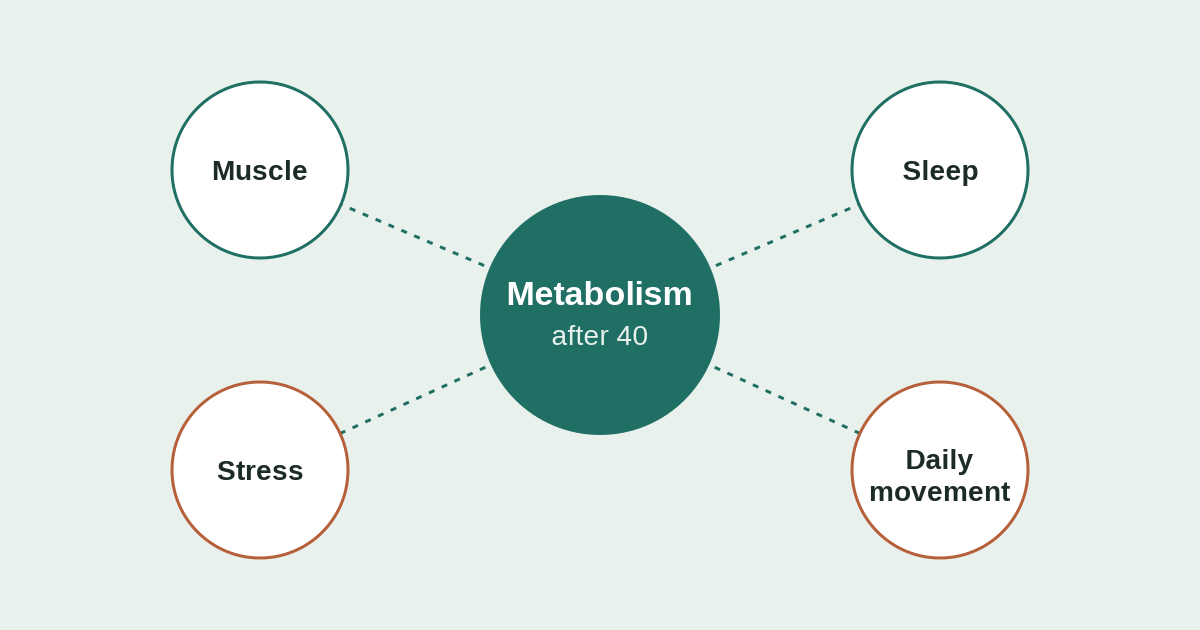
Because several everyday factors tend to shift at the same time: muscle mass, sleep, stress, hormones and daily movement. Each one nudges the energy budget a little. Together they can be enough to make old habits stop working.
Muscle mass
Muscle tends to decrease with age while fat tends to increase. Muscle uses energy even at rest, so losing some can lower the number of calories you burn. The Office on Women's Health says the same on its weight loss and women page: you lose muscle mass as you age, so you use fewer calories, and staying active helps you keep a healthy weight.
Sleep
Short or broken sleep makes the next day harder. You may reach for quick energy, skip the walk, and feel hungrier. Night sweats and worry, both common around menopause, can chip away at sleep without you noticing.
Stress
Many of us hit our 40s and 50s carrying a lot: work, aging parents, kids launching into adult life. Stress changes what we eat, when we eat and how much we move. It rarely shows up as a single dramatic event. It shows up as a hundred small shortcuts.
Daily movement
This one is sneaky. Planned workouts may stay the same while everything else shrinks: fewer errands on foot, more screen time, more sitting. The small, unplanned movement adds up more than we expect.
Hormones
That brings us to menopause, which deserves its own section.
What does menopause have to do with it?
The Office on Women's Health says it can be harder to lose weight after menopause. Lower estrogen may play a part, along with a slower metabolism with age, eating habits and activity level.
The Office on Women's Health notes that many women gain an average of 5 pounds after menopause. It lists lower estrogen as one possible factor, next to a slower metabolism with age, less healthy eating and being less active. The page is short and worth reading.
That matched my own experience. I did not suddenly eat differently. The body simply started to carry weight in a new place, and the plan I had used for twenty years needed an update.
If menopause is on your mind, that Office on Women's Health page is a calm place to start.
Want the full picture on Trimoryn?
I wrote a separate review that covers the label, the price and the 60-day guarantee, in plain words.
Read the full reviewWhat daily habits support a healthy metabolism after 40?
Move most days, strengthen your muscles twice a week, protect your sleep, manage stress and eat regular, balanced meals. None of it is glamorous. It is what the best sources point to, and it does not depend on a product.
1. Move on most days
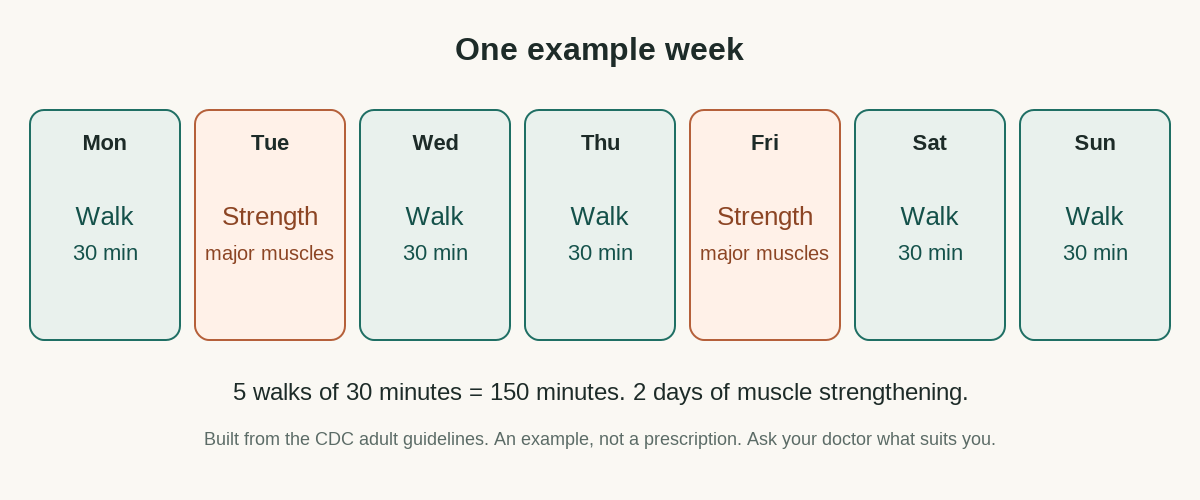
The CDC says adults need 150 minutes of moderate-intensity physical activity a week. That is five 30-minute walks. If 30 minutes feels like too much, three 10-minute walks count toward your day. Walking after a meal is an easy way to attach the habit to something you already do.
2. Strengthen your muscles twice a week
The same CDC guideline says adults need 2 days of muscle-strengthening activity each week. It can be bodyweight moves, resistance bands, weights or Pilates-style work that challenges your major muscle groups. Because muscle uses energy, it is one of the best places to invest. You can read the full guideline on the CDC website.
3. Protect your sleep
Keep a regular bedtime. Dim the lights an hour before. Keep caffeine earlier in the day.
4. Make stress smaller on purpose
A short walk outside, ten minutes of stretching, a phone call with a friend. These are not luxuries. They change what the rest of your day looks like.
5. Eat in a steady rhythm
For me, regular meals with vegetables, protein and fiber made hunger easier to read. I cook with simple, unprocessed food most days. How much protein is right for you depends on your body and your day.
How can I keep appetite steadier through the day?
Regular meals, fiber, enough protein, a glass of water and decent sleep help many people feel steadier between meals.
These are the small things I tried, one at a time, so I could tell what helped me:
- Sitting down to eat, without a screen, and slowing the first few bites.
- Adding a vegetable or a piece of fruit to meals I used to rush.
- Keeping a glass of water nearby, since thirst can feel like hunger.
- Planning a snack instead of grazing, so I knew what I was having and why.
- Going to bed on time, because tired days make everything harder.
None of this is a promise. Bodies are different, and what helps me may not help you. Treat it as a menu of small experiments.
Where do supplements fit in?
They are optional, and they come after habits, not instead of them. The FDA does not approve dietary supplements for safety and effectiveness before they are sold, so it is up to you to read the label and ask questions.
The FDA says it is not authorized to approve dietary supplements for safety and effectiveness before they are marketed. I link the FDA page in my label guide.
When a product says it "supports" something, the label says so in its own words. Research on each ingredient is the place to check, and the label is where the real details live.
I wrote two guides to help you check a label yourself. How to read a weight management supplement label walks through a real panel line by line. Green coffee bean, raspberry ketone and garcinia looks at three popular ingredients and what the research says about them.
I also added Trimoryn, which its label describes as "a one-capsule-a-day weight management support" product, to my routine, and I wrote a separate page about what is on its label and how its guarantee works. You will find it linked below.
Curious how this label looks in real life? See the full Trimoryn review.
Read the full reviewWho should talk to a doctor before trying anything new?
If you are pregnant or nursing, under 18, taking medicine or living with a health condition, check with a doctor or pharmacist first. The same goes if caffeine hits you hard, since the Trimoryn label lists 138 mg per capsule.
How can I start this week without overhauling my life?
Pick two small habits and keep them for two weeks. A 20-minute walk after dinner and a fixed bedtime are good starters. Add a strength session once those feel normal.
- Day 1: Take a photo of what you eat for a few days. Do not judge it, just look.
- Day 2: Choose a walking time that already fits your day.
- Day 3: Pick a fixed bedtime and set a reminder an hour earlier.
- Week 2: Add one 20-minute strength session, such as bodyweight moves or bands.
- Week 3: Add a second strength session and one more walk.
- Anytime: Book a check-up if it has been a while.
Be kind to yourself. It took years for things to shift, and it will take more than a week for them to settle.
What do I think after all this reading?
My take is simple: metabolism is not broken at 40, but the habits around it need updating. Start with movement, muscle, sleep and steady meals. If you consider a supplement, read the label first.
If you read one more thing, make it the label guide linked above. It is a useful skill in any aisle or on any website.
Want the full picture on Trimoryn?
I wrote a separate review that covers the label, the price and the 60-day guarantee, in plain words.
Read the full reviewFrequently asked questions
Does metabolism slow down at 40?
Not by much, according to a large 2021 study in Science. It found calorie burn stayed the most stable from the 20s through the 50s and declined gradually after 60. Changes in muscle, sleep, stress and activity explain more of what people notice.
Why is it harder to lose weight after 40?
Several things can pile up at once: less muscle, less sleep, more stress, hormone shifts around menopause and less daily movement. No single cause explains it for everyone.
Can you speed up your metabolism after 40?
You can support it. Regular walking, muscle-strengthening activity twice a week, steady sleep and enough protein are the habits with the best backing.
Does menopause slow your metabolism?
The Office on Women's Health says it can be harder to lose weight after menopause. Lower estrogen may play a part, along with a slower metabolism with age, eating habits and activity level.
What does the research say about weight management supplements after 40?
Research on weight management supplements is still developing, and the FDA does not approve dietary supplements for safety and effectiveness before they are sold. Read the label closely.
How much exercise do adults need each week?
The CDC says adults need 150 minutes of moderate-intensity activity a week and 2 days of muscle-strengthening activity. Start where you are and build up.
Should I take a supplement for metabolism?
That is a personal choice. Habits come first, and a supplement, if you choose one, is a small add-on.
Rebecca Hayes
After 40, what used to work for my weight stopped working, so I started reading about metabolism and kept going for years. I share what I learn in plain words.
I'm not a medical professional. Talk to your doctor before changing your routine or starting a supplement.
These statements have not been evaluated by the Food and Drug Administration. This content is for information only and is not medical advice. Results may vary. Talk to your doctor before starting any supplement, especially if you take medication.