
How to Read a Weight Management Supplement Label (With a Real Example)
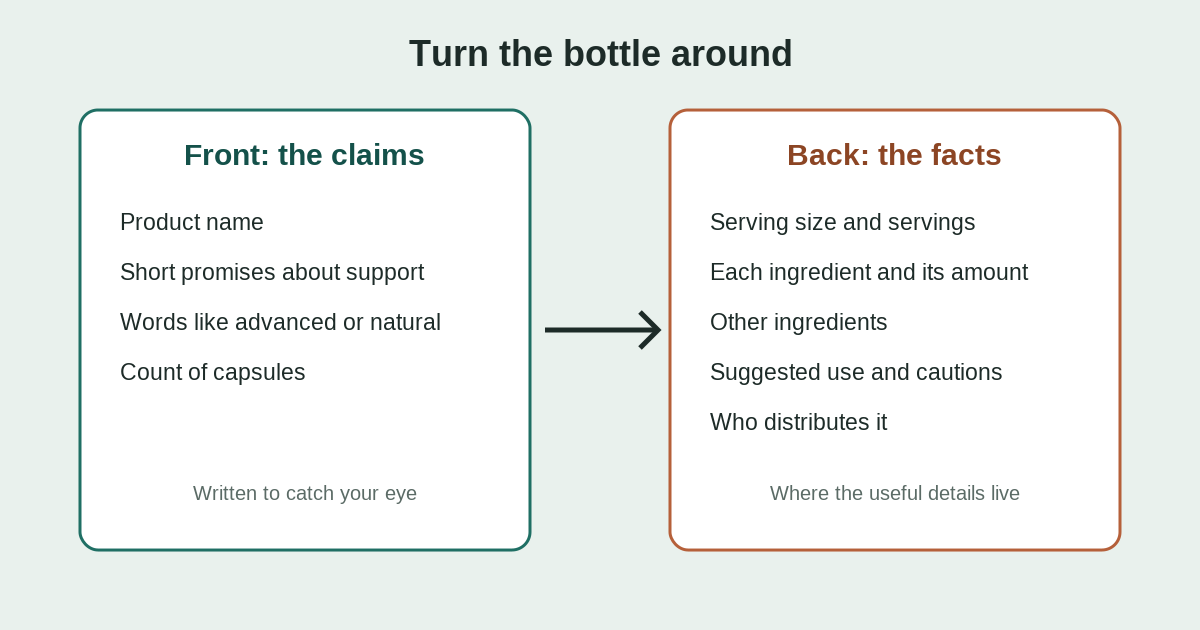
Turn the bottle around. The front shows claims, and the Supplement Facts panel shows what is inside. Check the serving size, each ingredient and its amount, the other ingredients, any caffeine and the caution notes. Then compare what the front says with what the back lists.
 By Rebecca Hayes · Updated November 27, 2026
This site may earn a commission if you buy through links on the review page. It does not change what we recommend.
The first time I really read a label, I was standing in a pharmacy aisle with my reading glasses in my hand. I realized I had always trusted the front, because it was the part written for me.
This is the guide I wish I had. It uses one real label as an example. I'm not a medical professional. Talk to your doctor before changing your routine or starting a supplement.
Why does the back of the bottle matter more than the front?
The front is written to catch your eye, with short claims and nice words. The back is where the law requires facts: what is in a serving, how much, and what cautions apply. When the two differ, the back is the more detailed source.
The FDA states on its consumer page that it is "not authorized to approve dietary supplements for safety and effectiveness before they are marketed." That makes your own reading more important, not less.
The label is where I start reading.
What does a Supplement Facts panel show, line by line?
It shows the serving size, how many servings are in the bottle, each ingredient with its amount per serving, a %DV column where a Daily Value exists, and an "other ingredients" line underneath.
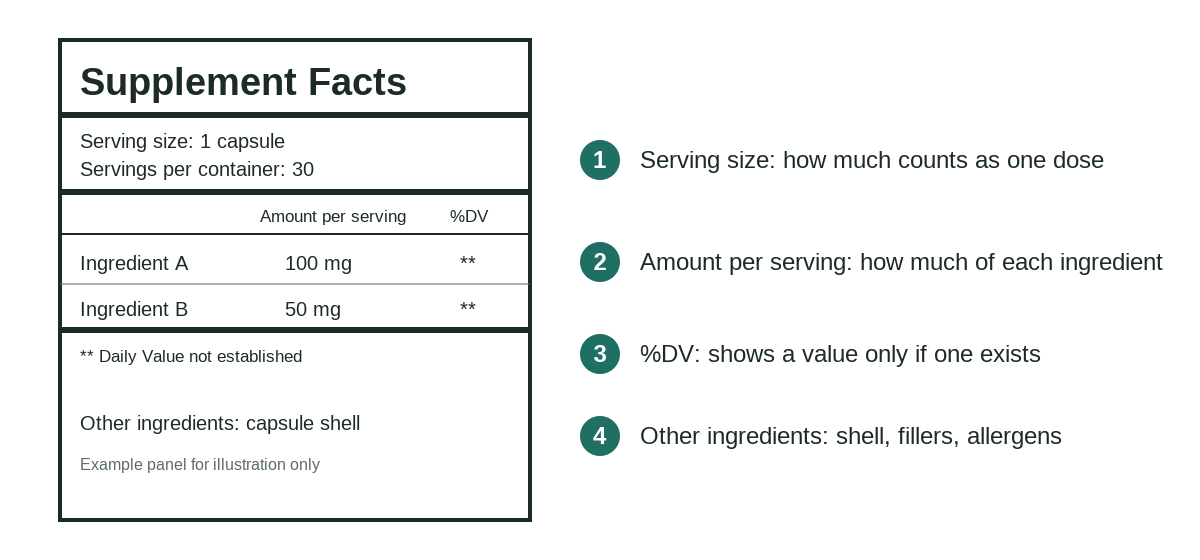
- Serving size. It tells you what counts as one dose, such as one capsule. Compare it with the suggested use.
- Servings per container. It tells you how long a bottle lasts. Thirty capsules at one a day is about a month.
- Amount per serving. Each ingredient should have its own amount. Add them up if you like. That is the real "dose."
- %DV. If it shows two asterisks and says "Daily Value not established," there is no official benchmark to compare against.
- Other ingredients. This is where you find the capsule shell, fillers and allergen or caffeine notes.
Are all the amounts always listed?
Not always. Some labels group ingredients in a blend with one total, which hides how much of each one you get. Look for a separate milligram amount beside every ingredient.
The label I use as an example below lists a separate amount for each of its five ingredients.
How can I tell if a supplement has caffeine?
Scan the panel for the word caffeine, then for sources that carry it, such as green tea extract, guarana or yerba mate. Read the line under the panel too. Some labels print "Contains Caffeine."
The FDA notes that supplements may voluntarily say how much caffeine they contain, so a missing number does not always mean a missing ingredient. It also says people differ widely in caffeine sensitivity. You can read more on the FDA caffeine page.
If you are pregnant, take medicine or have a health condition, talk to your doctor before trying a supplement with caffeine.
How should I read claims like "supports fat metabolism"?
Read them as the wording the label uses. An asterisk usually leads to the FDA note on the panel, which says the statements have not been evaluated by the Food and Drug Administration.
The FTC says health claims in advertising need "competent and reliable scientific evidence." You can see its approach in the FTC health products guidance. For you, the practical takeaway is to look for the evidence behind a claim, not only the claim itself.
Phrases like "advanced formula" or "clinically inspired" are descriptive wording. A phrase like "clinically tested" refers to a study, so it helps to ask which one. When a phrase refers to science, look for the study it points to.
Can you show me a real label, step by step?
Yes. Here is the Trimoryn label image from the manufacturer's page, read on November 27, 2026. I list what it says and the question I would ask next.
| Part of the label | What it says | Question to ask |
|---|---|---|
| Front | "Weight Management Support." Three claims, each with a little star (asterisk): supports fat metabolism, supports weight management, promotes energy and well-being. Also "Advanced formula, clinically inspired ingredients." 30 capsules, a one-month supply. | Where can I read the research on each claim? |
| Serving | 1 capsule is one serving. The bottle has 30 servings. | Does it match the suggested use? |
| Ingredients | Five ingredients, each with its own amount: green coffee bean extract (130 mg), raspberry ketone (130 mg), garcinia extract (130 mg), caffeine anhydrous (138 mg, plain caffeine powder) and green tea extract (130 mg). | What is each one? See the ingredient guide. |
| %DV | "Daily Value not established." That means there is no official number to compare with. | None needed, but it means no benchmark. |
| Other ingredients | Hypromellose, which is the plant-based capsule shell. It also says "Contains Caffeine." | Is there caffeine in this one? |
| Suggested use | One capsule a day with a glass of water (8 oz). It suggests taking it 20 to 30 minutes before a meal, or as your healthcare professional tells you. | Does this timing fit my day? |
| Caution | Do not take more than the label says. Pregnant or nursing mothers, kids under 18 and people with a known health condition should ask a physician first. Keep away from children. Do not use if the safety seal is broken or missing. | Do any of these apply to me? |
| Origin and distributor | "Manufactured in the USA with globally sourced ingredients." Sold by Trimoryn, with a PO Box in Ogden, Utah, a phone number and a support e-mail. | Can I reach the distributor if I have a question? |
Every ingredient has its own amount, and the caution is easy to find. For more detail on the research behind each ingredient, see the ingredient guide or contact the distributor.
Curious how this label looks in real life? See the full Trimoryn review.
Read the full reviewWhat do "other ingredients" and "standardized to" mean on a label?
"Other ingredients" lists the inactive parts, such as the capsule shell and fillers. "Standardized to" means the maker states the percentage of a marker compound in an extract. Both lines help you read the panel in full.
Check the serving size first, because every amount on the panel refers to one serving. Then read the other ingredients line for allergens and capsule material. If an extract shows a percentage, that figure describes the extract, not the total capsule. Keep a photo of the label for your records.
What is a quick checklist I can use in the store or online?
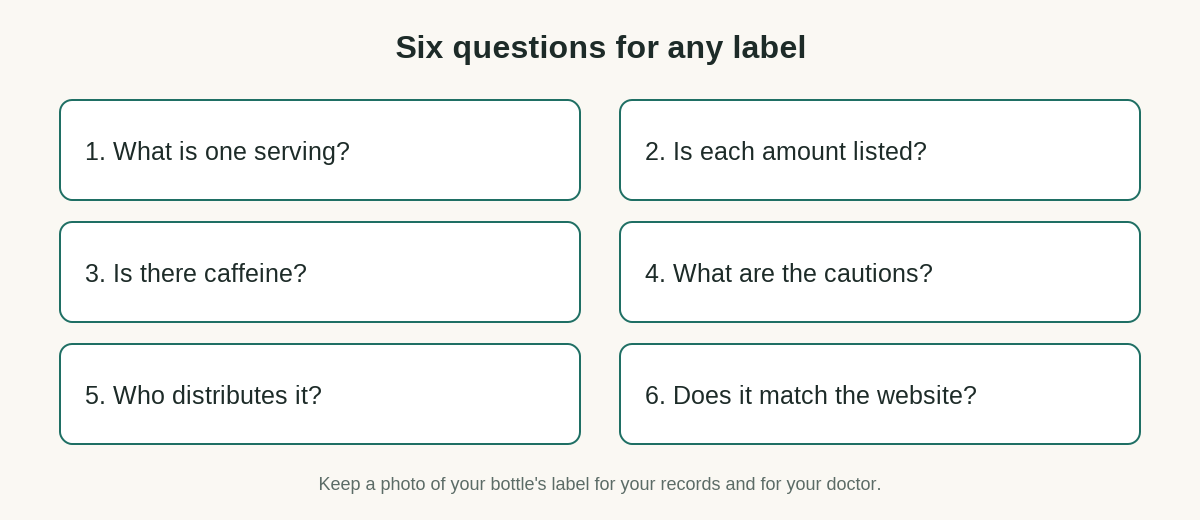
Check six things: the serving, each amount, any caffeine, the cautions, who distributes it, and whether the label matches the website. If one is missing or unclear, pause and ask.
- What counts as one serving, and how many are in the bottle?
- Does every ingredient list its own amount?
- Is there caffeine, and how much?
- Do any of the cautions apply to me?
- Who distributes it, and can I reach them?
- Does the label match what the website says?
For the bigger picture on habits, read the metabolism after 40 guide. A label is one tool, and daily habits are the foundation.
Want the full picture on Trimoryn?
I wrote a separate review that covers the label, the price and the 60-day guarantee, in plain words.
Read the full reviewFrequently asked questions
Where do I find the ingredient amounts on a supplement?
Look at the Supplement Facts panel on the back or side of the bottle. The Amount Per Serving column shows how much of each ingredient is in one serving.
What does Daily Value not established mean?
It means no official Daily Value exists for that ingredient, so the %DV column shows a symbol instead of a percentage. It does not say whether the amount is high or low.
Does the front of the bottle need proof?
Claims on the front still need to be supported by solid evidence under US advertising rules, according to the FTC. The FDA does not approve supplements for safety and effectiveness before they are sold, so reading the back matters.
How do I know if a supplement contains caffeine?
Check the Supplement Facts panel for caffeine, caffeine anhydrous, guarana, yerba mate or green tea extract, and read the other ingredients line. Some labels also say Contains Caffeine.
What do other ingredients and standardized to mean on a label?
Other ingredients lists the inactive parts, such as the capsule shell and fillers. Standardized to means the maker states the percentage of a marker compound in an extract. Both lines help you read the panel in full.
Rebecca Hayes
After 40, what used to work for my weight stopped working, so I started reading about metabolism and kept going for years. I share what I learn in plain words.
I'm not a medical professional. Talk to your doctor before changing your routine or starting a supplement.
These statements have not been evaluated by the Food and Drug Administration. This content is for information only and is not medical advice. Results may vary. Talk to your doctor before starting any supplement, especially if you take medication.